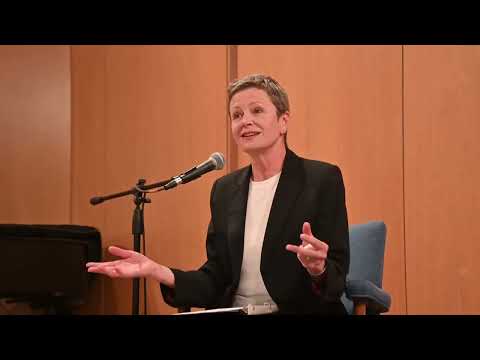
Kansas is among a handful of states that can conjure an imagery about its people just by the mention of its name, Thomas Fox Averill said Thursday.
Averill, who compiled a list of poems and essays about the sunflower state for his 1990 book “What Kansas Means To Me” spoke Thursday at Allen County Community college as part of the ACCC Speakers Series.
To illustrate his point, Averill mentioned a “Massachusetts Liberal,” a Texan and a Californian, all of whom lead to iconic stereotypes about those peoples.
Kansans are in the same boat, he contended, with our unique blend of Puritan morality, southern chivalry and western individualism.
He provided examples of each.
“Kansans have always believed we can create a place to make people a better people,” Averill said. “We’ve always thought we can create legislation to do moral good.”
Kansas was among the first states to enact prohibition laws in the early 20th century, and was also at the forefront of states creating laws giving voting and workers’ rights to women, Averill noted. Some of the nation’s first clean water rules were also were enacted here.
SUCH a reputation isn’t always to the state’s benefit.
Averill recalled the State Board of Education’s decision in 2005 to de-emphasize the teaching of evolution in public schools.
“Kansas wasn’t the only state that did that, you know,” he said, noting 14 states had passed such a measure, most of which were done before Kansas did.
“But we took the heat,” he said.
It should be noted the board reversed its decision a few years later to make evolution once again at part of the science curriculum.
The episode, however, reinforced Averill’s point. That when Kansans notice something, it becomes culturally significant for the country.
To a greater extent, the Kansas political landscape can be depicted by a swinging pendulum, he said.
On one side are those striving to find ways to make people’s lives better. On the other are those focused on privacy rights.
The pendulum today is in favor of privacy, Averill said.
“Don’t like it?” he asked rhetorically. “Don’t worry. It’ll swing back.”
THE SOUTHERN chivalry is evident every day, he said.
In Kansas, he noted, a cashier will strike up a conversation with a customer.
“There is a warmth here, a friendliness,” Averill said.
Meanwhile, the western individualism — a willingness to gamble — is typified by the Kansas farmer.
AVERILL ALSO touched on the Kansas landscape, and how it differs from other parts of the country.
He noted one magazine article that referred to the stretch of Interstate 70 spanning from Kansas City to Denver as “the most boring drive in America.”
The notion is incorrect, Averill said, for one simple reason: the sky, a virtual, ever-changing landscape.
“There is lots of beauty,” he said. “To me, the most boring drive in the country is the Pennsylvania Turnpike,” a curvy, mountainous route.
“You go around one curve, and what do you see?” he asks. “More trees.”
Kansas land also illustrates more than vast space, Averill said. A closer look shows vast time, with fossils found among the layers of sloughs and valleys.
“You won’t find that in places like you’ll find it in Kansas,” he said.
DESPITE its charms, Kansas is struggling, Averill conceded. The ongoing migration to urban areas has cut into the state’s rural population.
“But Kansas still has the potential to be paid attention to,” he said. “We still have opportunities to do things right. We have opportunities to use our iconic stature to make a difference.”
Kansas should embrace its heritage as a state of immigrants, Averill said. He noted that transplants from Germany were the first to establish successful farms in Kansas. Mexicans were vital in the construction of railroads. Even Vietnamese found their ways to Kansas to work in meat packing plants.
“We should fill our state with people who want to live in Kansas,” he said. “Maybe that means we have a rather large Mexican population. So?”
AVERILL’S talk is one of several as part of the ACCC Speakers Series focused on Kansas’ 150th anniversary of statehood this year, with most of the topics revolving around Sarah Smarsh’s book “It Happened In Kansas.”
The series continues next Thursday with a group discussion about “Serious Satire: Lasting Change in Today’s World.”
That discussion will include the essay “The Flying Spaghetti Monster,” written after the Kansas Board of Education voted to de-emphasize the teaching in evolution in 2005. It is from the “It Happened In Kansas” essays.
The author, Bobby Henderson, wrote about worshipping a creator that closely resembled spaghetti and meatballs to protest the teaching of intelligent design as an alternative to evolution.
The discussion will be in room B-35 on the Iola campus. A similar discussion follows Friday in Burlingame.