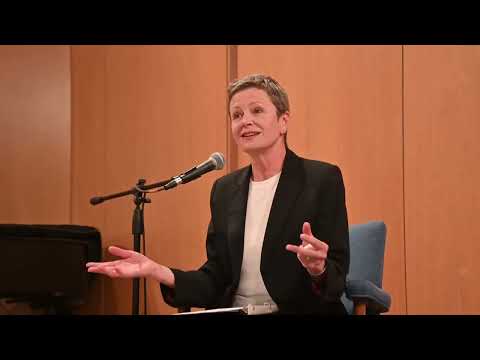
A stack of paper nearly 900 pages tall sat on a stool at the North Community Building in Iola Wednesday evening. It was wrapped up like a gift, but for those in the audience, it came with a warning.
Three Kansas nonprofits — the Alliance for a Healthy Kansas, Kansas Action for Children, and Kansas Appleseed — hosted an event called “Big Bill, Big Problems” to unpack what they described as the harsh consequences of H.R. 1, a sweeping federal law nicknamed the “One Big Beautiful Bill.”
“We’re here tonight to talk about H.R. 1,” said John Wilson, president and CEO of Kansas Action for Children, pointing to the bound legislation. “If it looks like a gift, I’m here to tell you it’s most likely not a gift for anybody in this room.”
Wilson likened the law to a storm that may appear beautiful from afar but brings destruction once it arrives. “There are a lot of people out there promoting this as a really good thing for Kansans,” he said. “But we wanted to come out here tonight to share the story about the severe consequences that will likely come from this storm.”
He pointed to three key outcomes for Kansans: 26,000 people losing Medicaid coverage, 27,000 losing SNAP benefits, and 25,000 children losing the child tax credit worth $2,000 annually. “That’s money families need for groceries, housing, transportation — the basics to get by,” Wilson said.
ADRIENNE Olejnik, vice president of Kansas Action for Children, expanded on why Medicaid and SNAP were targeted in the bill.
“You may wonder — why were Medicaid and SNAP such a big part of this bill? Essentially, it was to pay for tax changes,” she told the audience.
Olejnik explained that lawmakers used cuts to Medicaid and SNAP to offset the cost of tax provisions included in the reconciliation bill. Despite those cuts, the bill still adds an estimated $3.4 trillion to the federal debt.
She detailed several tax provisions, noting that many are temporary and may not provide the benefits families expect. Popular promises like eliminating taxes on tips and overtime, and giving seniors extra money, are included — but all expire after tax year 2028. Relief for overtime wages won’t appear until spring 2026, when families file their taxes, and is capped at $25,000 with fine print that could reduce its impact.
Other changes include raising the deduction cap for state and local taxes from $10,000 to $40,000, which Olejnik said would benefit very few Kansans and is set to expire in 2029. She also briefly discussed the creation of “TRUMP accounts,” a temporary savings program for babies born between 2025 and 2028. Families can contribute up to $5,000 annually, but in practice, Olejnik said, the accounts function more like traditional IRAs. “We were pretty disappointed,” she said. “This really didn’t pay out in the final bill the way it was promised.”
NATHAN KESSLER, principal economist at Kansas Action for Children, followed with a deeper dive into the less “flashy” permanent tax changes.
“The core and most expensive piece of this bill is making the 2017 tax cuts permanent,” Kessler said. “Many people may not feel like they’re getting a tax cut at all because this bill doesn’t change anybody’s tax rates.”
He noted small increases to the standard deduction — $750 for single filers and $1,500 for married couples — and a modest boost to the federal child tax credit from $2,000 to $2,200. But many low-income families won’t qualify for the full credit, and 25,000 Kansas children will lose it entirely due to new eligibility rules.
Kessler warned that higher-income households will reap most of the benefits, pointing to a $200 billion cost from raising the estate tax exemption to $15 million. “Great news if you’re set to inherit $14.99 million,” he quipped. “For the rest of you, I bet $14 million would have done just fine.”
Kessler attributed the addition of $3.4 trillion to the national debt to rising interest rates, higher borrowing costs, and ultimately, higher bills for Kansans. “That’s the only trickle I’m getting from this bill,” he said.
He also highlighted the repeal of renewable energy credits, which could increase household power costs by more than $200 a year by 2030 and $650 by 2035. Meanwhile, tariffs designed to raise federal revenue are driving up everyday prices on imported goods — from toys to coffee. “The bottom line is that this is a bill that steals from the future to pad the pockets of the wealthy today,” Kessler said.