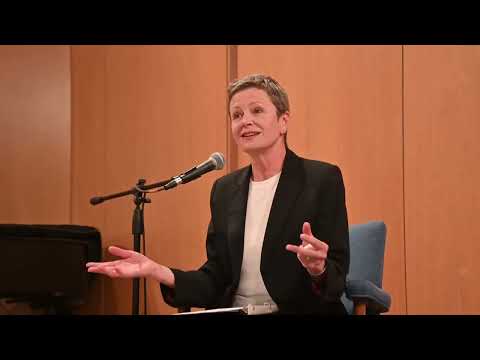
Dawny Barnhart, then a graduating senior, bid goodbye to Iola in 1989. She returned this year, a doctor.
It’s the hope of most small-town folks, when they launch their best young people out into the world, that, in time, those young people will come back. And when they return, their heads full of knowledge or their hands fluent in a new trade, it’s a bonus if they’ve acquired a skill that answers to that region’s need.
It would be impossible to overstate the steep need for mental health professionals in southeast Kansas. Installed as a licensed psychiatrist at the Community Health Center of Southeast Kansas in July, Dr. Barnhart is one of only a handful of board-certified mental health professionals in the area.
According to the Department of Health and Human Services, more than half of the 3,075 rural counties in the U.S. lack even a single trained mental health expert. This, despite the fact that the incidence of mental illness and substance abuse in rural America is outpacing the numbers in cities.
BARNHART’S intention was always to come back to Iola. When she met her partner, Jonathan Adams, in 2012, in Kansas City, she remembers telling him, essentially: “Now, there’s something you need to know about me. I’ve committed my life to medicine and I really want to be in southeast Kansas.”
But Barnhart’s route back to her hometown charted a fairly scenic route.
After a precocious career at Iola High School, Barnhart enrolled at John Brown University, in Siloam Springs, Ark., where she majored in history with a focus in Russian studies. It was the right time for it. The Cold War was over, the wall had come down, the Stalin archives were just unearthed, and Sovietologists were thick on the ground at every university. “And so my intent,” recalled Barnhart,“was to get a graduate degree in Russian studies.” She’d spent a profitable semester abroad studying in Nizhny Novgorod — that old haunt — a riverine city six hours east of Moscow. And so it was no surprise when, after graduating from John Brown, Barnhart was accepted at the Center for Russian, East European & Eurasian Studies at the University of Kansas.
Partway into her graduate studies, however, Barnhart left KU. “The call of the real world came,” she remembered. Appropriately, the call came from a telephone company, Sprint, where Barnhart clocked in and out each day until the monotony of that life became too much to bear.
Some way into her tenure at Sprint, Barnhart fell into a conversation with her cousin, a doctor at the Mayo Clinic in Minnesota. “I told him I wasn’t cut out for the corporate world. And he said: ‘Then why don’t you think about becoming a doctor?’ I was 31.”
Barnhart thought and prayed on the subject for a long while: Maybe it’s not too late, she thought, maybe I can do this.
AT 38 YEARS old, Barnhart entered medical school at the Virginia College of Osteopathic Medicine, in Blacksburg. Her mentors at VCOM recognized in Barnhart a more empathic, more emotionally intelligent figure than the 20-somethings who usually filled those corridors. “I guess, maybe because I was older, I had a compassion and an understanding of people in unusual situations, where a lot of the younger kids might be scared off by somebody acting ‘not normal.’” The field of mental health, then, seemed a natural fit for someone with such delicate antennae for the inner life.
And so her course in psychiatry was set. She entered into a residency program at the University of Missouri–Kansas City, where – through her training at Truman Medical Center – she was exposed to the full menu of scenarios that might greet the professional psychiatrist in the course of a career.
Upon completing her residency, Barnhart accepted the job at CHC and was reunited, at last, with Iola.
IN IDENTIFYING the mental health challenges facing rural states, the American Psychological Association focuses on three “A’s”: availability – the chronic shortage of mental health providers; accessibility – the lack of knowledge of behavioral health options, the lack of proper medical insurance, and the long distances residents must travel to meet their nearest expert; and acceptability – the harsh stigmas and reduced anonymity that limits a rural resident’s likelihood of seeking services.
Barnhart is at pains to address all three at her practice at CHC, where she attends to patients in both Iola and Pittsburg. “I tell them,” said Barnhart, “that mental health and suffering is just as valid as physical health and suffering. … A healthy mind is just as important as a healthy body.”
Barnhart’s expertise, as she describes it, is in “medication management — knowing exactly the right diagnosis, the right medication, and the right dosing,” but she insists on meeting in person with her patients for the initial interview.
For those whose circumstances don’t allow them to travel to either Iola or Pittsburg, Barnhart does allow videoconferencing appointments.
Her special passion — and another fact that makes her arrival vital to the future health of southeast Kansas – is for the treatment of drug and alcohol addiction, an arena she’ll pursue with more rigor as her career progresses.
BARNHART is the daughter of Denney Barnhart and Denice Stahl, and the granddaughter of Dennis Williams, the well-respected former owner of the Iola Greenhouse. She returns to an Iola much different from the one she left. “It’s changed so drastically,” reflected Barnhart. “As I’ve grown as a person, I think Iola has too.” She and Adams, both outdoors enthusiasts — who seem, in appearance, to have strolled straight out of the pages of an REI catalog — are passionate users of the Lehigh Portland Trails. “I’m loving it here,” said Adams. “We go to the Community Band concerts in the summer, the parades, Farm-City Days. … We go to anything we can.”
“All of a sudden, I have a commodity,” said Barnhart, reflecting on her long path back to Iola, “a valuable tool that can be used in a community that I love and that I know is desperately in need.
“I’m in this for the long haul.”
In Iola, Barnhart can be reached at 365-6600; Pittsburg, 620-231-9873.