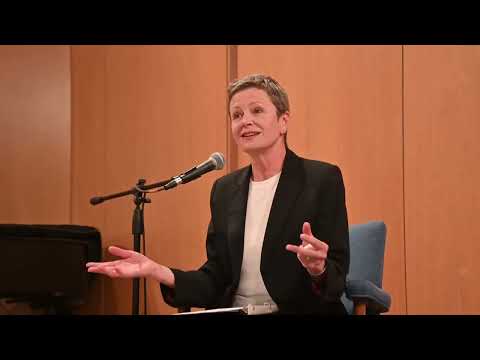
Aleksander Sternfeld-Dunn, a professor of music at Wichita State University and an amiable evangelist for the importance of the arts in public education, appeared before a small crowd in the recital hall at the Bowlus Fine Arts Center on Wednesday to make, as the title of his lecture spelled out, “The Case for Creativity.”
Sternfeld-Dunn didn’t attempt the sentimental job of arguing that exposure to the arts will improve the private sphere of your soul — though, as a highly-regarded composer himself, he doubtlessly believes this. His plea for creativity, rather, centered on the use-value of the arts and their practical application in a modern economy.
FACING a loose horseshoe of about 25 interested citizens — and standing before two big-screen TVs — Sternfeld-Dunn showed a still shot taken from an old episode of NBC’s “Today Show.” The segment, based on a popular Newsweek article, purported to educate the viewer on the “top 5 useless” college majors in the U.S. The image to which Sternfeld-Dunn drew the audience’s attention was a commonplace graphic listing the catalog of curricular duds: 1) fine arts; 2) drama and theater; 3) film, video and photographic arts; 4) commercial art and graphic design; and 5) architecture.
“But oh,” exclaimed Sternfeld-Dunn, “the irony.” What the perpetrators of this graphic failed to realize, explained the professor, “is that this slide was probably created by somebody who has a degree in graphic arts. The show was being filmed by people who have backgrounds in film and photographic arts. It is being recorded in a building that was designed by an architect. And the way the company makes its money is by hiring a lot of actors and writers.”
The received opinion regarding the study of the arts and humanities — that they don’t serve the economy or provide material benefit to the student who pursues them — is simply wrong, argued Sternfeld-Dunn. “I think we forget how embedded the arts are in our daily life.”
As such, the emphasis on creativity should be a staple of K-12 education across the country, argued Sternfeld-Dunn. “You’ve heard of STEM?” he asked, referring to the renewed push to boost student achievement in the disciplines of science, technology, engineering and mathematics. “Well, it’s a lie. It needs to be STEAM. We need to add an ‘A’ in there for the arts.”
HUGE SWATHS of students who earn humanities degrees as undergraduates are accepted into medical school every year, said Sternfeld-Dunn. Same with law school. In fact, he continued, most law schools “would actually prefer you have a degree in the humanities, because the training” — learning to think critically, to marshal clear arguments, to write — “is so akin to what you need to be doing as a lawyer.”
Sternfeld-Dunn recalled falling into conversation with the president of one of the state’s largest banks at a recent strategic planning committee meeting at WSU. “This is what she told us: ‘I don’t really care what you teach them as far as technology and computer programs, because, quite frankly, they’re going to be outdated by the time they graduate. … In four years, we’ll be using different software, different predictive models, the economy will have changed. That doesn’t matter to me. The reasons we require a bachelor’s degree for employment are 1) because it shows that they can complete something rather difficult; 2) it speaks to their ability to think critically and think creatively; 3) it says to me that they know how to work as a team; and 4) a bachelor’s degree has some sort of speech component, which means they know how to communicate.
‘The software? I can teach them the software.’”
Plenty of ink has been spilled in the last half-century about the outsourcing of blue-collar jobs. But work previously regarded as white-collar — accountants, for example — are now losing out to automation, too. “Do you know who did my taxes this year?” asked Sternfeld-Dunn. “TurboTax.”
The good news, however, stressed Sternfeld-Dunn, is that “the one thing that cannot be outsourced and cannot be done by a computer is creativity. And that is something that, for all its foibles, America has in spades. … Which means, if we can’t outsource it and we can’t computer program it, then we really have to inject it into our curriculums for our kids.”
And that, argued Sternfeld-Dunn, needs to start early.
“I KNOW the Bowlus is going through an interesting phase in its relationship with the public school right now,” said Sternfeld-Dunn, stepping cautiously around the details of pending legal negotiations between the fine arts center and USD 257, whose futures were twined nearly 60 years ago in the will left by local philanthropist Thomas Bowlus. “There are obviously a lot of ways to deal with that relationship, but one thing I will say is that the model that you guys have right now is an incredibly unique model. And it could be a powerful model for the rest of the country. The idea of a charitable arts organization paired with the public school system — I can’t think of a model like this anywhere else. It actually does itself really well by these kids. I mean, wow — what I would have given to be a middle schooler or a high schooler on the stage in this building! Or to create art in this environment that was built around the very idea of art. It’s an amazing thing.”